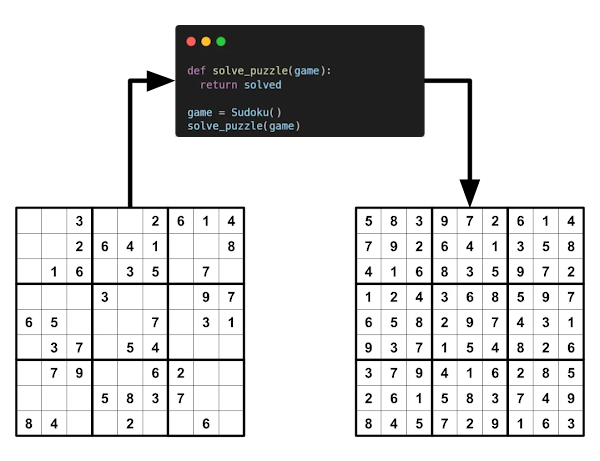
Sudoku for Dummies: Learn Sudoku From Absolute Zero
Sudoku has exactly one rule: every row, every column and every 3×3 box must contain the digits 1 to 9, each exactly once. That is the whole game. There is no arithmetic, no vocabulary, no trivia and nothing to memorise — if you can tell nine symbols apart, you can solve a Sudoku. This guide takes you from never having touched a grid to finishing an easy puzzle unaided, using only two techniques, and shows you exactly what to do when you get stuck.
What you are looking at
A Sudoku is a 9×9 grid, so 81 cells. Those 81 cells are divided three different ways at the same time, and every cell belongs to all three.
| Group | How many | What it must contain |
|---|---|---|
| Row | 9 across | 1 to 9, each once |
| Column | 9 down | 1 to 9, each once |
| Box (3×3 square) | 9, marked by thicker lines | 1 to 9, each once |
The puzzle starts with some digits already printed. Those are the givens, and they never change. Your job is to fill in every empty cell so all 27 groups are complete.
The rule stated three ways
Beginners sometimes hear the rule and still misapply it, so here it is from three angles.
- As a filling rule. Fill every empty cell with a digit from 1 to 9.
- As a banning rule. A digit cannot repeat in a row, in a column, or in a box.
- As a counting rule. Each of the nine digits appears exactly nine times in the finished grid — once per row, once per column, once per box.
There is no rule about diagonals in a standard Sudoku, none about sums, and none about the numbers being in order. If you catch yourself trying to add anything up, you are playing a different puzzle.
The digits are not numbers
This is the thing that unlocks Sudoku for people who think they are bad at maths. The digits 1 to 9 are just nine distinct symbols. Replace them with nine colours, nine letters or nine animal drawings and the puzzle is exactly identical. Nothing is ever added, subtracted, multiplied or compared.
Digits are used only because everyone can tell them apart instantly and they are easy to write in a small square. If you have avoided Sudoku because of the numbers, you have been avoiding it for a reason that does not exist.
Technique 1: cross-hatching (the one you will use most)
Cross-hatching answers the question "where can this digit go in this box?" It is how almost every easy Sudoku is solved from beginning to end.
- Pick a digit. Start with whichever appears most often in the grid — more copies means more constraints, which means faster progress.
- Pick a box that does not have it yet. One of the nine 3×3 squares.
- Cross out the rows. If a row passing through the box already contains your digit somewhere, no cell in that row inside the box can hold it.
- Cross out the columns. Same logic for the three columns passing through the box.
- Look at what survives. If exactly one empty cell is left, your digit goes there. Write it in.
- Move on. Same digit, next box. Then the next digit.
Work digit by digit rather than cell by cell. Beginners usually stare at an empty cell and ask "what goes here?", which is the hardest possible question. Asking "where does this 5 go in this box?" is far easier and produces answers much faster.
Technique 2: the naked single
The other question is the reverse: "what can go in this cell?" Pick one empty cell and list what is banned — every digit already in its row, its column and its box. If eight digits are banned, the ninth is forced.
Naked singles appear constantly in the later stages of a puzzle, when rows and boxes are nearly full. Early on, cross-hatching is much more productive.
Your first puzzle, step by step
- Scan the whole grid first. Which digit appears most? Which boxes are fullest? Start where there is most information — not at the top-left corner.
- Cross-hatch that digit through all nine boxes. Place every one you can find.
- Move to the next most common digit. Repeat.
- After each placement, re-check. One new digit changes the constraints for its whole row, column and box. A cell that was ambiguous a moment ago may now be forced.
- When cross-hatching dries up, switch to naked singles. Look for the emptiest-looking cells in the fullest rows and boxes.
- Keep alternating. An easy puzzle will fall to these two, cycling between them.
Pencil marks: when and how
A pencil mark is a small candidate digit written in a corner of a cell — the digits still possible there. They are useful and they can also drown you.
| Do | Do not |
|---|---|
| Mark a cell when it is down to two or three candidates | Mark every empty cell at the start — it is unreadable and slow |
| Write them small, in a consistent corner | Write them large enough to confuse with real answers |
| Erase a candidate the moment it is eliminated | Leave stale marks — they cause almost every beginner error |
| Use them on medium and hard puzzles | Rely on them for easy puzzles — try without first |
On an easy grid, try to solve with no marks at all. It is slower at first and it builds the scanning habit that makes everything afterwards easier.
The five beginner mistakes
- Guessing. The big one. Every legitimate Sudoku is solvable by pure logic. A guess that turns out wrong corrupts the grid twenty moves later, and you will not know where it went wrong.
- Forgetting the box. Beginners check rows and columns carefully and forget the 3×3 box constantly. It is the constraint that makes the puzzle work — check it every time.
- Doing arithmetic. There is none. If you are adding, you have misunderstood the puzzle.
- Writing an answer you are not sure of. Only write a digit when you can say why it must be there. "It looks right" is a guess in disguise.
- Starting in the corner. Start where the information is — the fullest box, the most common digit — not where the grid begins.
What to do when you are stuck
Stuck does not mean the puzzle is unfair. On an easy grid it almost always means one of these five things.
| Check this | Why |
|---|---|
| Have you tried every digit 1–9 in every box? | Beginners abandon a digit too early. Be systematic |
| Did you check the box, not just row and column? | The most common oversight by far |
| Is there a mistake earlier in the grid? | Scan for a repeated digit in any row, column or box |
| Are you looking at cells instead of digits? | "Where does this 7 go?" is much easier than "what goes here?" |
| Have you re-scanned since your last placement? | Each new digit unlocks fresh deductions immediately |
If you find a repeated digit, you have made an error. Erase back to a point you are confident about rather than trying to patch it — patching a broken grid never works.
Difficulty levels: what they actually mean
Difficulty is not about how many digits are missing. It is about which techniques the puzzle forces you to use.
| Level | What it needs | Ready when |
|---|---|---|
| Easy | Cross-hatching and naked singles | Now — start here |
| Medium | Naked pairs, hidden pairs, pointing pairs | You finish easy puzzles without help |
| Hard | Box/line reduction, triples, X-Wing | Medium feels routine |
| Expert | Swordfish, XY-Wing, chains | You have hard puzzles under control |
Stay on easy until easy is boring. Jumping to medium too early is the most common reason people conclude Sudoku is not for them.
Your first two weeks
- Days 1–3. Easy puzzles only, no timer, no pencil marks. Use a solver when you stall — and read why the move works.
- Days 4–7. Still easy, still untimed. Aim to finish without help. Speed does not matter at all yet.
- Days 8–11. Easy puzzles finished consistently? Try one medium. Expect to get stuck; that is where you learn the naked pair.
- Days 12–14. Learn one new technique properly — the naked pair — and use it deliberately in every puzzle.
Two weeks of fifteen minutes a day is enough to go from never having solved one to finishing medium puzzles. The only thing that reliably slows people down is starting too hard.
Your third technique: the naked pair
When cross-hatching and naked singles both dry up, this is almost always the move that restarts the puzzle. It is the first technique that eliminates candidates rather than placing digits, and learning it is the real step from beginner to competent solver.
Find two cells in the same row, column or box that both have exactly the same two candidates — say both can only be 3 or 7. You do not know which cell holds which. But you know for certain that between them they use up both the 3 and the 7 in that group. So no other cell in that group can be 3 or 7, and you can strike those candidates out everywhere else in the row, column or box.
That elimination usually cascades. Removing a 3 from a third cell may leave it with a single candidate, which places a digit, which unlocks its whole row and box. One naked pair frequently unblocks an entire puzzle.
Paper or app for your first month
| Paper | App | |
|---|---|---|
| Catching mistakes | You must find them yourself — slower, teaches more | Flags them instantly — faster, teaches less |
| Pencil marks | You choose what to write | Often auto-filled, which does the thinking for you |
| Distraction | None | Ads, timers, streaks |
| Convenience | Need a book and a pencil | Always in your pocket |
For learning, paper wins clearly — the error-checking and auto-candidates in most apps remove precisely the work you are trying to practise. Once the techniques are solid, use whichever you prefer. If you do use an app while learning, turn off auto-candidates and error highlighting.
Frequently asked questions
What are the rules of Sudoku?
One rule: every row, every column and every 3×3 box must contain the digits 1 to 9, each exactly once. Nothing else.
Do I need to be good at maths?
No. There is no arithmetic in Sudoku at all. The digits are nine distinct symbols and could be replaced by nine colours without changing the puzzle.
Where should I start on a puzzle?
With the digit that appears most often in the grid, and the box that is already fullest. Start where the information is, not at the top-left corner.
What is cross-hatching?
Picking a digit and a box, then eliminating every cell in that box whose row or column already contains the digit. If one empty cell survives, the digit belongs there.
What is a naked single?
A cell where eight of the nine digits are already banned by its row, column and box. The remaining digit is forced.
Should I write pencil marks?
Not on easy puzzles — try without. On medium and above, mark only cells down to two or three candidates, and erase eliminated candidates immediately.
Is guessing ever allowed?
No. Every properly made Sudoku is solvable by logic alone. A wrong guess corrupts the grid many moves later with no way to trace the error.
How do I know if I made a mistake?
Scan every row, column and box for a repeated digit. If you find one, erase back to a point you are sure of rather than patching — patching a broken grid never works.
How long should an easy puzzle take?
Anywhere from five to thirty minutes when you are starting out. Time is irrelevant at this stage — finishing without guessing is the only goal.
Why can I not find the next move?
Usually because you are asking "what goes in this cell?" instead of "where does this digit go in this box?" The second question is far easier and is how easy puzzles are meant to be solved.
When should I move up a difficulty level?
When your current level is boring rather than merely possible. Moving up too early is the single most common reason beginners give up.
Are there rules about diagonals?
Not in standard Sudoku. Diagonal or X-Sudoku is a separate variant that adds that constraint, and it will always say so.
What is the fewest clues a puzzle can have?
17, proven by exhaustive computer search in 2012. As a beginner you will not meet one — easy puzzles typically start with 36 to 45 givens.
Is Sudoku the same everywhere?
Yes. It contains no words, so a Sudoku printed in Tokyo, São Paulo or Manchester is identical. That is exactly why it spread worldwide so quickly.
Where to go from here
Once easy puzzles are comfortable, the next step is learning your third technique. Move on to our beginner's guide to rules and first steps, then 15 tips and tricks that actually help, and keep our free solver open for whenever a grid stalls.