Homepage Sudoku Solver - Free Online Sudoku Solutions, Step by Step
Sudoku Solver – Free Online Sudoku Solutions, Step by Step
Enter your puzzle in the grid above and press Solve. Our free online Sudoku solver returns the complete solution in under one second for any valid 9×9 grid — easy, medium, hard, expert, evil or diabolical. It validates every digit as you type, so a duplicate in any row, column or 3×3 box is flagged immediately. No sign-up, no download, no limit, and you can export the solved grid as a PNG to print.
People reach this page looking for very different things — a sudoku solver, the sudoku solutions to a grid they have already half-finished, a free sudoku solver with no sign-up, a sudoku helper that reveals one digit, or simply someone to solve this sudoku for them. All of it is here. This page is both the tool and the complete reference: how the solver works, how to solve Sudoku yourself from the first rule to forcing chains, every variant and grid size, the history of the puzzle, and answers to more than thirty of the questions people ask most.
How to use the Sudoku solver
The solver sits at the top of this page. It is an online Sudoku solver that runs entirely in your browser — your grid is never sent to a server, there is no rate limit, and it keeps working even if your connection drops after the page has loaded.
- Enter your puzzle. Click any cell and type a digit from 1 to 9. Move between cells with Tab or the arrow keys. Leave a cell blank wherever the printed puzzle is empty.
- Watch the live validation. If a digit conflicts with one already on the grid, a message appears at once naming the clash — row, column or 3×3 box. This alone makes the tool a fast sudoku checker.
- Press "Solve Sudoku". The complete solution appears in well under a second, even for expert and diabolical grids.
- Export or print. Press "Export as PNG" to save the solved grid as an image you can print, file or share.
- Press "Reset" to clear the board and start another puzzle. There is no limit on how many grids you solve.
What is a Sudoku solver?
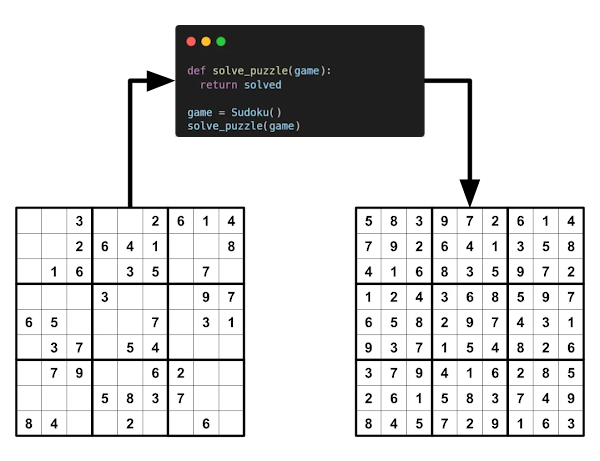
A Sudoku solver is a program that takes a partially filled 9×9 grid and computes the one completion satisfying all three rules: every row, every column and every 3×3 box containing the digits 1 to 9 exactly once.
It does not guess. A proper sudoku solution solver searches systematically, testing each candidate against every constraint, and either returns the unique valid answer or reports that the grid is impossible. If your puzzle contains a contradiction — two 8s in the same row — there is no solution to find, and it tells you so instead of inventing one. Because any properly constructed Sudoku has exactly one answer, the solution a sudoku answers tool gives you is the answer, not an answer. More on what a free Sudoku solver can and cannot do for you.
Features of this free Sudoku solver
| Feature | What it means for you |
|---|---|
| Instant solutions | Under one second for any valid 9×9 grid, including expert, evil and diabolical puzzles. |
| 100% accurate | A backtracking algorithm explores the search space exhaustively. It cannot return a wrong answer. |
| Live error checking | Duplicate digits in a row, column or box flagged as you type. Works as a standalone sudoku checker. |
| Completely free | No account, no email, no trial, no limit on puzzles solved. |
| Private | Everything runs in your browser. Your puzzle never leaves your device. |
| Mobile friendly | Fully responsive grid. Tap a cell and type on phone or tablet. |
| Print & download | Export the solved or partial grid as a PNG image. |
| Keeps working if you drop offline | Once the page has loaded, the solver keeps running even if your connection cuts out. |
| No installation | A sudoku solver online that opens in any modern browser. |
Every kind of Sudoku solver, explained
People search for a solver in many different ways. Here is what each term means and how this tool relates to it.
Step by step Sudoku solver
A step by step sudoku solver, or sudoku solver with steps, shows the order in which cells become forced rather than just the final answer. The value is educational: you see that a cell was a hidden single, that a naked pair two boxes away eliminated the alternative. Work the grid yourself and use the solver to confirm one cell at a time.
Sudoku solver with hints
A sudoku solver with hints, also called a sudoku hint giver or sudoku helper, reveals a single digit instead of the whole grid. This is the healthiest way to use any solver: take one cell, close the tool, go back to your paper and work out why that digit was forced.
Hard Sudoku solver
A hard sudoku solver is not a different program — if you want to beat those grids yourself, start with the techniques that actually work on hard Sudoku. A backtracking algorithm does not care about human difficulty: a grid that takes a person forty minutes and requires forcing chains takes software the same few milliseconds as an easy one. Human difficulty and machine difficulty are almost unrelated.
9x9 and 3x3 Sudoku solver
Standard Sudoku is what a 9x9 sudoku solver handles: nine rows, nine columns, nine 3×3 boxes. People searching for a 3x3 sudoku solver usually mean the same thing — naming the 3×3 boxes inside the 9×9 grid. Both land here.
Sudoku calculator, completer and scanner
Sudoku calculator and sudoku completer are alternative names for the same tool, though "calculator" is misleading since there is no arithmetic in Sudoku. A sudoku scanner or sudoku solver picture tool uses your camera and OCR to read a printed grid; it saves typing at the cost of frequent misreads on newspaper print. Typing 25 to 30 digits takes about a minute and is error-free, which is why this solver uses keyboard entry.
Variant solvers
A Killer Sudoku solver, sudoku x solver, wordoku solver, samurai and jigsaw solvers each need their own constraint logic. This tool handles standard 9×9 grids: for a variant, place what you can using the variant rules, then enter the partial grid here to finish it — the rest is ordinary Sudoku.
What is Sudoku? The rules in plain language
Sudoku is a logic puzzle on a grid of 81 cells, nine across and nine down, divided by thicker lines into nine 3×3 boxes. Some cells arrive with numbers already printed; these are the givens or clues and never change. You fill in the rest.
- Each of the nine rows contains the digits 1 to 9, once and only once.
- Each of the nine columns contains the digits 1 to 9, once and only once.
- Each of the nine 3×3 boxes contains the digits 1 to 9, once and only once.
That is the entire rule set — nothing about diagonals, sums, or the order digits appear in. Two consequences matter enormously. First, every cell is constrained three times: it belongs to one row, one column and one box simultaneously, and any digit already present in any of those three is eliminated from that cell. Second, a proper Sudoku has exactly one solution, which is precisely why you never need to guess.
Sudoku is not a maths puzzle
The biggest misconception, and it stops many people before they start. You never add, subtract, multiply or divide. The digits 1 to 9 are nine distinct symbols that happen to be easy to tell apart. Replace them with nine letters and the puzzle is identical — that variant is sold as Wordoku. What Sudoku actually tests is systematic elimination and working memory, which is why people who call themselves bad at maths are often excellent at it. Never filled a grid before? Start with Sudoku from absolute zero.
How to solve Sudoku: every technique in order
1. Where to start
Not the top-left corner. Spend twenty seconds finding the fullest 3×3 box, the fullest row and column, and the digit that appears most often across the grid. Crowded areas and frequent digits are the most constrained, so they give up answers first. A digit placed six times blocks six rows, six columns and six boxes; its three remaining placements are usually forced.
2. Cross-hatching (scanning)
The first real technique, and it finishes most easy grids alone. Take one digit — say 5 — and one box that does not contain it. Eliminate every row through that box already holding a 5 elsewhere, then every column. If exactly one cell survives, that cell is the 5. Sweep the digit through all nine boxes, then move to the next. Two or three complete passes solve almost every easy puzzle. Our beginner guide to the rules and first steps walks through a full grid this way.
3. Hidden singles and naked singles
A naked single is a cell that can hold only one digit because the other eight already appear in its row, column or box — found by asking "what can go here?" A hidden single is a digit that can go in only one cell of a unit, even though that cell could take other digits — found by asking "where can this digit go in this unit?" Hidden singles are far more common in medium grids, and beginners miss them constantly because they only ever ask the first question. The complete guide to solving Sudoku covers both questions in order.
4. Pencil marks
When scanning stops producing answers, write candidates — the small digits listing everything that could still legally go in each empty cell. Every technique beyond this point operates on candidates. Three rules: do not mark the whole grid too early, be complete when you do mark, and strike a candidate the instant you place that digit elsewhere in the unit. Stale pencil marks are the number one cause of Sudoku errors.
5. Naked pairs, hidden pairs and triples
A naked pair is two cells in one unit holding exactly the same two candidates, say 4 and 7. Between them they consume both digits, so 4 and 7 leave every other candidate list in that unit. A hidden pair is the mirror: two digits that can appear in only two cells, letting you delete every other candidate from those cells. A naked triple extends this to three cells sharing three candidates, and they need not each hold all three.
6. Pointing pairs and locked candidates
The best return on effort of any advanced technique. If every remaining candidate for a digit inside one box lies in the same row, that digit must land in that row within that box — eliminate it from the rest of that row outside the box. The reverse, claiming or box-line reduction, works identically. Sweeping all nine digits takes two minutes and typically produces four or five eliminations on a hard grid.
7. X-Wing
Pick a digit. Find two rows where it has exactly two candidate cells each, in the same two columns. The four cells form a rectangle: whichever way the digit resolves it occupies one corner in each row, so it appears in both columns inside the rectangle and can be eliminated from every other cell in those columns. The same pattern works from columns — solvers who only scan rows miss half the X-Wings on the board. Worked examples of X-Wing, Swordfish and XY-Wing are in our advanced Sudoku techniques guide.
8. Swordfish and Jellyfish
Swordfish is the X-Wing on three rows and three columns: find three rows where a digit has two or three candidates each, all inside the same three columns, and eliminate it from the rest of those columns. It does not require all nine intersections — only that candidates never stray outside the three columns. Jellyfish is the four-by-four version: valid, and almost never necessary.
9. XY-Wing and XYZ-Wing
The XY-Wing uses three two-candidate cells: a pivot reading {X, Y} and two pincers seeing the pivot reading {X, Z} and {Y, Z}. Whichever value the pivot takes, one pincer is forced to be Z — so Z leaves every cell that sees both pincers. The XYZ-Wing is the same with a three-candidate pivot and stricter eliminations.
10. Unique Rectangle
The only technique exploiting a property of the puzzle rather than the numbers: a proper Sudoku has exactly one solution. Four cells forming a rectangle across exactly two boxes, all holding only the same two candidates, would be completable two ways — impossible. In the common case three corners read {A, B} and the fourth reads {A, B, C}: the fourth must be C.
11. Simple colouring
When a digit has exactly two candidate cells in a unit they form a conjugate pair — exactly one is the digit. Colour one blue, its partner green, and follow every link alternating colours. Two conclusions: any uncoloured cell seeing both a blue and a green cannot hold the digit (colour trap), and if two same-coloured cells share a unit, that colour is entirely false and every opposite-colour cell is the digit (colour wrap). Colour wrap is the most powerful single move in standard Sudoku.
12. Forcing chains
Take a two-candidate cell, assume the first value and propagate, then return and assume the second. If both assumptions force the same digit into the same cell, that digit is certain regardless. This is not guessing: you test both branches and keep only what they agree on. Once the techniques are automatic, the next step is solving Sudoku faster.
Sudoku difficulty levels explained
Most people assume difficulty comes from having fewer clues. It largely does not — a 24-clue grid can be trivial and a 30-clue grid brutal. Real difficulty is set by which techniques a human is forced to use.
| Level | Techniques required | Typical time |
|---|---|---|
| Easy | Cross-hatching, hidden and naked singles only | 2–5 min |
| Medium | Adds pencil marks, naked and hidden pairs, triples | 5–10 min |
| Hard | Adds pointing pairs, box-line reduction, X-Wing | 10–25 min |
| Expert | Adds XY-Wing, W-Wing, Swordfish, Unique Rectangle, colouring | 20–45 min |
| Evil / diabolical | Requires forcing chains and nets | 45 min + |
| Extreme | Multiple interlocking long chains — AI Escargot class | Hours |
The fewest clues a valid Sudoku can have is 17, proved in 2012 by an exhaustive computer search at University College Dublin. Around 50,000 distinct 17-clue puzzles are known and many are rated only medium — the clearest demonstration that clue count and difficulty are different things. For the extreme end, see which Sudoku is the hardest and how Sudoku puzzles are designed.
Sudoku variants and grid sizes
Every variant keeps the core rule — no repeated symbol in any row, column or region — and adds or changes exactly one constraint.
A short history of Sudoku
Sudoku was not invented in Japan, despite the name. The mathematical ancestor is the Latin square, studied by Leonhard Euler in Switzerland in the 1780s — a grid where each symbol appears once per row and column, with no box rule and no puzzle attached. Between 1892 and 1895 French newspapers ran number puzzles remarkably close to modern Sudoku; La France published one in July 1895 with the full 3×3 sub-square rule. That line died out around the First World War.
The modern puzzle was created in 1979 by Howard Garns, a retired architect from Indianapolis, and published by Dell Magazines as Number Place. Dell never credited him; he died in 1989, fifteen years before it became famous. In April 1984 the Japanese publisher Nikoli introduced it to Japan, where it was published under the name sūji wa dokushin ni kagiru — "the digits must remain single" — soon shortened to Sudoku. Nikoli's president Maki Kaji is the name most associated with the puzzle's rise in Japan. Nikoli capped the givens at 32 and introduced the 180-degree rotational symmetry used almost everywhere today.
It went global because of Wayne Gould, a New Zealand-born judge in Hong Kong who saw one in a Tokyo bookshop in 1997, spent six years writing a generator, then gave the puzzles to newspapers free in exchange for a credit link. The Times of London published its first on 12 November 2004; within fourteen months Sudoku was in newspapers on every continent, and the first World Sudoku Championship was held in Lucca, Italy, in March 2006. The full story is in who created Sudoku puzzles, where Sudoku was invented and when Sudoku was most popular.
Is Sudoku good for your brain?
Sudoku exercises four things: working memory (holding candidates in mind while checking a third constraint), sustained attention (ten to forty minutes of uninterrupted focus), visual pattern recognition and logical reasoning. It exercises no arithmetic at all.
The largest relevant research is the PROTECT cohort at the University of Exeter and King's College London, covering more than 19,000 adults aged 50 to 93. Participants who regularly did number puzzles scored better on tests of attention, reasoning and memory, and the association grew stronger with frequency.
Two honest caveats. That study is observational — it shows a correlation, and people who choose daily puzzles may differ in education, health or leisure time. And the wider cognitive-training literature consistently finds strong improvement on the practised task with weak transfer to unrelated abilities. Sudoku will make you markedly better at Sudoku. There is no good evidence that it prevents dementia, and anyone concerned about cognitive health should speak to a doctor rather than rely on puzzles. We look at the evidence in detail in is Sudoku good for your brain, can Sudoku make you smarter, Sudoku, memory and concentration and the mental health side of playing Sudoku.
Ten mistakes that keep people stuck
- Guessing. Every proper Sudoku is solvable by logic. A wrong guess produces a contradiction thirty moves later that you cannot trace.
- Checking only rows and columns. The 3×3 box is the third constraint and where most forced cells hide.
- Asking only one question. "What goes here?" finds naked singles. "Where does this digit go?" finds hidden singles — far more common.
- Pencil-marking too early. On easy grids it costs three minutes and hides the placements you could have scanned.
- Leaving stale pencil marks. Every placement invalidates candidates elsewhere. Update instantly.
- Starting top-left. Start at the most constrained box, not in reading order.
- Working cell by cell. Work digit by digit across the whole grid. Far fewer checks for the same result.
- Rushing. One wrong digit costs ten to twenty minutes. The half-second check is always worth it.
- Escalating too fast. Hunting a Swordfish while an unplayed hidden pair sits on the board wastes the puzzle.
- Not checking for an error. A hard grid with no legal next move usually contains a mistake, not a hidden pattern.
Fifteen more habits that make a measurable difference are collected in our Sudoku tips and tricks.
Sodoku, Suduko, Sudoko — which spelling is right?
Sudoku is correct. It comes from the Japanese sūji wa dokushin ni kagiru: su means number, doku means single. The common misspellings all refer to the same puzzle and all reach this solver: sodoku, soduku, suduko, sudoko, suduku, sudoki, sedoku, sudoke, sodocu, sudocu, siduko and saduko. If you typed any of them, the grid at the top of this page works exactly the same.
Sudoku glossary
| Term | Meaning |
|---|---|
| Cell | One of the 81 squares you write a digit in. |
| Given / clue | A digit printed at the start. Never changes. |
| Unit | Any row, column or 3×3 box. Every cell belongs to exactly three. |
| Candidate | A digit that could still legally go in a particular cell. |
| Pencil mark | A candidate written small in a cell as a reminder. |
| Naked single | A cell with only one remaining candidate. |
| Hidden single | A digit with only one possible cell in a unit. |
| Naked pair | Two cells in a unit sharing the same two candidates. |
| Pointing pair | A digit confined to one row or column within a box. |
| Conjugate pair | Two cells that are the only candidates for a digit in a unit. |
| Band / stack | Three boxes in a horizontal row / vertical column. |
| Backtracking | The search algorithm this solver uses: try, recurse, undo on failure. |
Frequently asked questions about Sudoku and Sudoku solvers
Is this Sudoku solver free?
Yes, completely and permanently. No account, no email, no download, no trial and no limit on how many puzzles you solve. The solver runs in your browser, so there is no server cost per solve and therefore no reason to charge or rate-limit.
How do I use an online Sudoku solver?
Type the numbers from your printed puzzle into the matching cells of the grid at the top of this page, leaving blank whatever is blank on paper, then press Solve. The completed grid appears in under a second. Press Export as PNG to save or print it.
Can it solve any Sudoku puzzle?
It solves any valid 9×9 Sudoku, including hard, expert, evil and diabolical grids — even puzzles designed to defeat human solvers, such as AI Escargot. If a grid has no solution because it contains a contradiction, the solver reports that instead of inventing an answer.
Does the solver work on mobile?
Yes. The grid is fully responsive on phones and tablets. Tap a cell and enter a digit with your keyboard. Nothing needs to be installed.
Is my puzzle sent to a server?
No. The solver runs entirely in your browser using JavaScript. Your grid never leaves your device, which is why there is no rate limit and why the tool keeps working if your connection drops after the page loads.
What if the solver says my puzzle has no solution?
The grid contains a contradiction — a repeated digit somewhere in a row, a column or a 3×3 box. It may be in the original puzzle, but far more often it is a digit you placed yourself earlier. Compare your entries against the printed puzzle first.
Can I print the solution?
Yes. Press Export as PNG and the solved grid is saved as an image file you can print or share. The export captures exactly what is on screen, so you can also save a partially solved grid.
How do you solve a Sudoku puzzle step by step?
Survey the grid for the fullest box and the most frequent digit. Cross-hatch each digit 1 to 9 through every box to find hidden singles, and repeat until no new placements appear. Then add complete pencil marks and apply naked pairs, hidden pairs and pointing pairs, updating candidates after every placement.
What is the objective of Sudoku?
To fill every empty cell of the 9×9 grid so that each row, each column and each 3×3 box contains the digits 1 through 9 exactly once, with no repeat in any of those units.
Is there a trick to solving Sudoku?
Ask two questions instead of one. "What can go in this cell?" finds naked singles. "Where can this digit go in this unit?" finds hidden singles, which is where most placements in medium grids come from. Beginners only ever ask the first.
Do you ever need to guess in Sudoku?
No. A properly constructed Sudoku has exactly one solution reachable by logic alone. If you feel forced to guess, you have either missed a technique or made an error earlier. Check every unit for a duplicate digit first.
How does a Sudoku puzzle work?
Each empty cell sits in three overlapping units — its row, its column and its 3×3 box. Any digit already present in any of those three is eliminated from that cell. Solving narrows those eliminations until one digit remains, then repeats as each placement changes the picture elsewhere.
What is the easiest way to solve Sudoku?
Cross-hatching. Take one digit at a time, look at each 3×3 box that does not contain it, eliminate every row and column already holding that digit, and place it if exactly one cell survives. Two or three passes solve most easy puzzles with no pencil marks at all.
How do you solve hard Sudoku?
Hard grids are solved by elimination rather than placement. Build complete pencil marks, then work in order through naked and hidden pairs, pointing pairs, X-Wing, XY-Wing, Swordfish, Unique Rectangle and colouring. Long stretches without placing a digit are normal.
What is an X-Wing in Sudoku?
A digit with exactly two candidate cells in each of two rows, with those cells in the same two columns. The four cells form a rectangle, and the digit must occupy one corner in each row — so it can be eliminated from every other cell in those two columns.
What is a naked pair?
Two cells in the same row, column or box holding exactly the same two candidates. Those digits are locked into those two cells in some order, so both can be removed from every other candidate list in that unit.
Why do I get stuck on hard Sudoku?
Either your pencil marks are stale, so you are hunting patterns in a grid that no longer matches the placed digits, or you are applying placement techniques when the puzzle requires elimination techniques such as pointing pairs and X-Wing. Wipe your marks, rebuild them, and re-scan all 27 units.
How long should a Sudoku take?
For an experienced solver: easy 2 to 5 minutes, medium 5 to 10, hard 10 to 25, expert 20 to 45. Beginners should expect roughly double, which shortens quickly with practice. Competitive solvers finish hard newspaper grids in about ninety seconds — see how they get a puzzle down to a minute.
How many possible Sudoku grids are there?
There are 6,670,903,752,021,072,936,960 valid complete 9×9 grids. Accounting for symmetries such as rotation, reflection and digit relabelling, 5,472,730,538 are essentially different.
What is the minimum number of clues in a Sudoku?
Seventeen. A 2012 exhaustive computer proof at University College Dublin confirmed that no valid 16-clue Sudoku with a unique solution exists. Around 50,000 distinct 17-clue puzzles are known, many only medium difficulty.
What is the hardest Sudoku ever?
Arto Inkala's 2012 puzzle, which he rated 11 on a scale of 1 to 10. His earlier grid AI Escargot, published in 2006, held the title before it. Both defeat every standard technique and require long forcing chains — though this solver finishes either in milliseconds.
Is Sudoku a maths puzzle?
No. There is no arithmetic in Sudoku at all — no addition, subtraction, multiplication or division. The digits are nine distinct symbols and could be replaced by letters or colours, which is exactly what Wordoku does.
Is Sudoku good for your brain?
It exercises working memory, sustained attention and logical pattern recognition, and large observational studies associate regular number puzzles with better cognitive test scores in adults over 50. It does not appear to produce broad gains in unrelated abilities, and there is no good evidence that it prevents dementia.
Where was Sudoku invented?
In the United States. Howard Garns, an architect from Indianapolis, created it in 1979 and Dell Magazines published it as Number Place. It reached Japan in 1984, where Nikoli renamed it Sudoku. The Latin square ancestor was studied by Euler in Switzerland in the 1780s.
What does the word Sudoku mean?
It is short for the Japanese phrase suji wa dokushin ni kagiru, meaning "the digits must remain single". Su means number and doku means single — the name is a compressed statement of the rule itself.
Sodoku, Suduko or Sudoku — which is correct?
Sudoku. Sodoku, soduku, suduko, sudoko, suduku, sudoki, sedoku and sudoke are all common misspellings of the same puzzle, and all of them reach this solver. The grid works identically whichever way you spelled it.
What is Killer Sudoku?
A variant where the grid is divided into dotted-line cages, each with a target sum. Digits in a cage must add to that number with no repeat inside the cage, on top of the normal rules. Killer grids usually start with no givens. The key technique is the rule of 45: every row, column and box totals 45.
What is Sudoku X?
A variant where both main diagonals must also contain the digits 1 to 9 with no repeats. It is often easier than standard Sudoku despite sounding harder, because the two extra constraints give two more places to find forced cells.
Does this solver handle Killer, Samurai or Jigsaw Sudoku?
Not directly — those variants need their own constraint logic. Use the variant-specific rules to place as many digits as you can by hand, then enter the resulting partial grid here and the solver will complete it, since the rest is ordinary Sudoku.
What algorithm does the solver use?
Backtracking: it finds an empty cell, tries the digits 1 to 9, keeps any that does not violate the row, column and box constraints, then recurses. If every digit fails it undoes the last placement and tries the next option. Because constraints can be checked on a partial grid, most branches are discarded immediately. We break the code down line by line in how a Sudoku solver algorithm works.
Will using a solver stop me improving at Sudoku?
Only if you copy the answer without thinking. Used properly — reveal one cell, then work out why that digit was forced — it accelerates learning far faster than staring at a stuck grid.
How do I get faster at Sudoku?
Sweep digit by digit rather than cell by cell, and start with the digit that already appears most often. Follow every cascade after a placement instead of restarting your scan. Delay pencil marks until scanning stops working. Most solvers halve their medium-grid time within a month.
Popular Posts